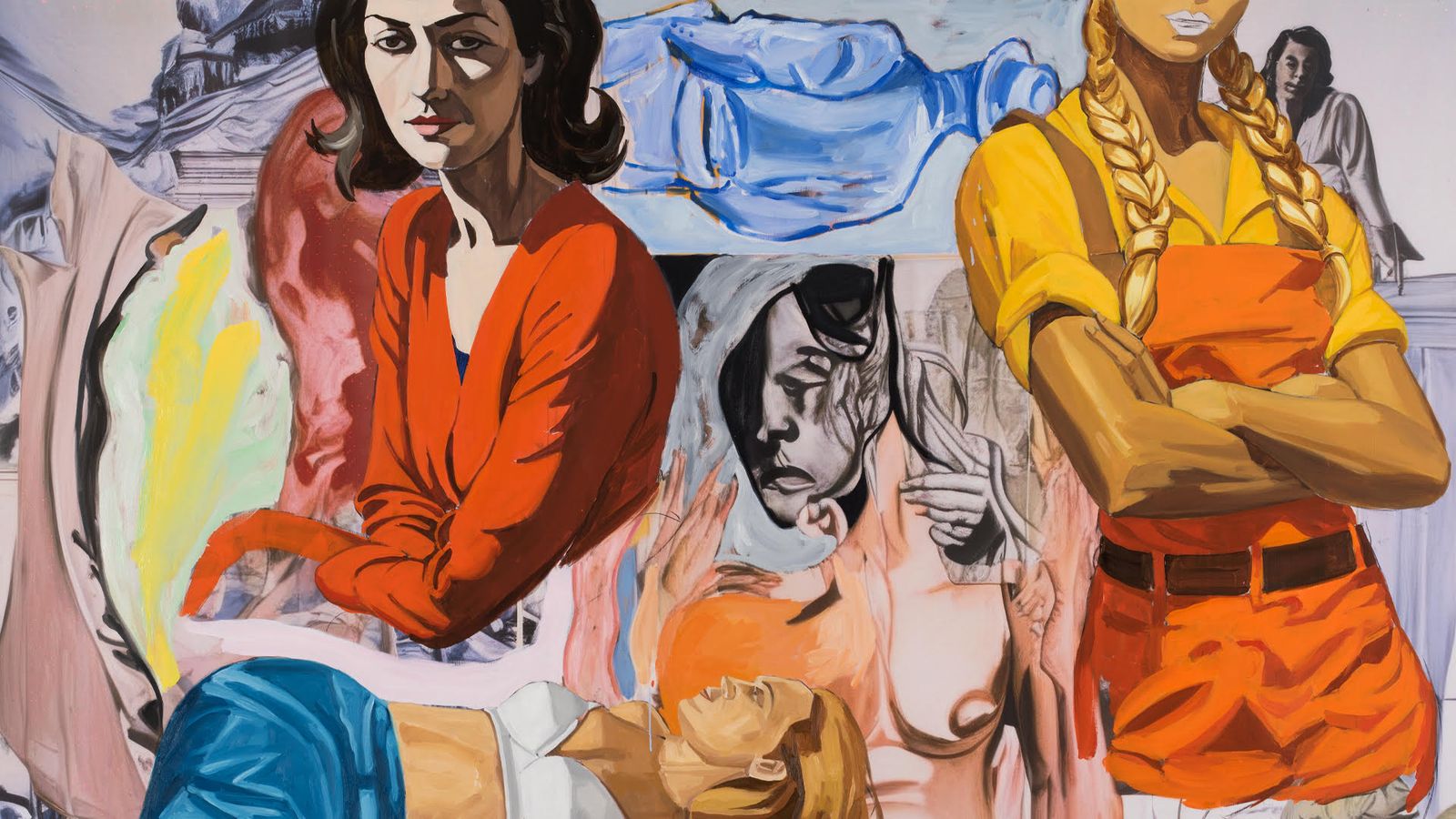
For his exhibition at the Palazzo Cini Gallery, David Salle refocuses a custom-designed AI model on an earlier part of his oeuvre, the Tapestry Paintings (1990–91). In doing so, he highlights painting’s ability to collapse multiple temporal realities onto a single plane: ‘Everything in painting exists in the present tense,’ as he says.
The original Tapestry Paintings were based on 18th-century Russian tapestries, which were themselves modelled after 16th- and 17th-century Italian paintings. This layering of art history now comes into contact with Salle’s proprietary AI model. Organised around cubist-like grids informed by Salle’s signature inset panels – separate panels cut into and set flush with the surface of the painting, whose presentation of simultaneity has been seen to have anticipated the logic of computer screens – the painted tapestries become grounds over which the artist composes his distinctive poetic juxtapositions. Salle has been quick to adopt new technologies into his painting practice throughout his career – a testament to his belief that ‘the best way to subvert the dominance of technology is to co-opt it for different ends.’ In the rooms of Palazzo Cini, Salle’s painterly inquiry unfolds against its own historic backdrop.
